Showing posts with label horticulture. Show all posts

Friday, August 23, 2024

One From Eighteen Years Ago


Hunting The Rhubarb

Yesterday was Kerry Sister's mumbly-mumbleth birthday. As her birthday was almost totally forgotten last year we decided to mark the occasion with a Rhubarb Hunt. I told them I'd found rhubarb growing in the moss but no one believed me. So I led an expedition to prove that I was right.

The Kerry Sister and the Leitrim Sister on the hunt for The Rhubarb. The Kerry Sister is kicking spoor for clues. The Leitrim Sister prefers to sniff the air for that elusive Rhubarb scent.

The Rhubarb has been spotted! Leitrim Sister says it is a lot of bollocks and that it is False Rhubarb.

The Rhubarb


Bert is horticulturally highly qualified and he thinks it is Rhubarb. It looks like, smells like, tastes like, and smokes like Rhubarb.


Macy prefers to wallow in a moss hole.


The Mystery Solved


Rhubarb growing in Drumkeeran Moss remained a puzzle until, six years later, I met Bobby.


Bobby was Lord O'Neill's man on the ground, the mossy ground, to be precise. The day I met him he was admiring a patch of narcissi that he'd planted the previous autumn. He told me that his wife was throwing the bulbs out so he thought he'd plant them in the moss to see how they'd do. Now, as far as I know, he just got the one year out of them as I never saw them again. I did ask him If he'd ever tried rhubarb and he said he had but it hadn't made much of a plant. The mystery solved!

Sunday, April 30, 2006

My Report To The Management


A PLANTING SCHEME FOR MINGERTON

A Report by Nelly Moser

Berkheya purpurea

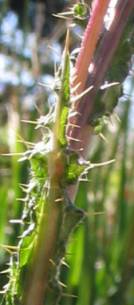
A fast-growing, long-lived perennial, Berkheya purpurea has a long, single taproot and forms a dense clump of very prickly foliage tight on the ground. The large green leaves arranged in a rosette are up to 250 mm long with wavy, very spiny edges. The upper surfaces of the leaves are almost shiny, whereas the cobwebby undersides are covered with long, soft, white hairs. Smaller leaves are produced along the single flowering stem; these leaves diminish in size upwards and their bases continue down the stem forming broad spiny wings running down the stem-an interesting feature of Berkheya purpurea.

The strong flower stem is produced in summer in the centre of the plant, and it can stand up to a metre tall. They are protected by large, spiny green bracts which fold open with the flowers to form a flat shield at the back and close again after flowering to protect the seed heads. Each flower lasts a few days and a single plant can have up to 15 flowers open at one time.

Every part of this attractive plant is spiny and is capable of inflicting a lot of pain on the unwary vandal. I would recommend its planting in the raised bed in the courtyard and in all the beds surrounding the building.

Ruta graveolens (Rue)

Evergreen perennial bush with yellow flowers and blue-green attractive frondy foliage. Also known as Herb of Grace (repentence) due to its bitter taste. It was believed hundreds of years ago that Rue would guard against witches, and innkeepers would give some to travellers for safety. Grows to about 3 ft (92 cm) high. Very aromatic. Makes a strong disinfectant and insect repellent when leaves are strewn across the floor.

Dioscorides recommended it for the treatment of snakebite, as he reckoned that weasels ate the leaves before fighting snakes. He also claimed it had contraceptive properties. Plant Rue round buildings to keep out snakes. In Medieval and Tudor times it was one of the main ingredients for exorcism. Juice has been used for earache.
Plant in a sunny site and cut back by half in spring to keep it compact. Plant lasts longer in poor, dry soil than good soil.

CAUTION - SEVERELY TOXIC TO SKIN WITH SUNLIGHT (the sap may render the skin excessively sensitive to strong sunlight resulting in painful blistering, so handle with care)

This plant has a multitude of uses. Insects, snakes and witches are repelled. Its disinfectant properties will be useful, as will its properties as a cure for earache as this is a frequent hazard in our work. It should also prove to be vandal-resistant thanks to its toxic properties. I recommend planting it all round the building and also in window boxes to maximise its snake and witch repelling properties.

Pyracantha coccinea ‘Red Column’ Firethorn

A vigorous plant with small evergreen, oval, dark green leaves. Bears corymbs of tiny white flowers at the end of spring, which are followed by long lasting scarlet berries. Best grown in well-drained soil in full sun or part shade. As its name suggests it’s a thorny plant. I would advise training it up walls to discourage visitors and clients from entering and leaving the building through windows.


Berkheya Purpurea

Ouch!

Tuesday, September 14, 2004

Flipping Clematis

I have been asked for advice about overwintering clematis in pots. Bert the resident expert has been consulted and this is what he suggests. He overwinters clematis both as liners and full-grown plants. They are kept in unheated polytunnels. He advises some frost protection if it is very cold and to plant out in spring. Don’t worry if they die back a bit, as they’ll sprout again in spring. Don’t overwater. Good luck!

Thursday, September 02, 2004

Dinner from the Garden

September is not so bad at all. Last night we ate the first of the sweetcorn Tonight Nelly’s garden offered onions, peas, carrots and spinach. Mr Tesco (shame on me) offered mince and Mr Bisto provided the gravy. Wee Herbie the farmer provided the spuds, which Bert picked from the field. When wee Herbie comes to pay the rent on those fields Bert had better give him a good luck penny. I said to him recently “Won’t he mind?” Bert said “He won’t mind as long as I don’t do it in front of him.”

Daughter three said to me the other day that she thought this blog was a good idea but she went on to say “Just don’t make it all about gardening.” She is not keen as is evident by her choosing to live in Stoke. When she was younger she pointed to a dandelion and asked, “Is that a plant or a tree?” This for her was the major division in things horticultural. She wasn’t even that young as she was doing her A levels at the time. You will probably have guessed that biology wasn’t one of her subjects.

Keeping on the horticultural/agricultural theme I must report that I heard an unpleasant rumour recently. There is a college not far from here that would specialise in these subjects and I have heard that some of the students at this college are eating the animals! Namely ducks and pedigree lambs. I suppose it would be difficult to redd up a bullock in one barbecue sitting. Something has got to be done about student poverty. I wonder do they eat the laboratory rats in Coleraine.